
Gamifying public transport in Bangalore to increase ridership

Client
NDA
Services
Naming, Branding, UX Research, Mobile Application design
Tools Used
Figma, FigJam, Jira, Illustrator
Project Overview
Problem
Urban commuters in Bengaluru face significant challenges with real-time public transport information, route planning, and trust in last-mile connectivity. These issues result in delays, confusion, safety concerns, and over-reliance on private vehicles, worsening traffic congestion and pollution.
Despite available transport apps, users report fragmented experiences, lack of live updates, limited multimodal integration, and minimal support for diverse commuting needs (e.g., differently-abled users, elderly, tourists).
Proposed Solution
The effectiveness of transportation systems relies heavily on individual and their behaviors. Implementing a gamified interactive transit system introduces competition, rewards, and social engagement as behaviourial interventions. Public transport passengers, acting as players, have the opportunity to earn rewards by utilizing bus or metro services.
The Process

Primary Research
Actor Mapping

System Mapping

Public Transport in Bangalore
Transport in Bangalore consists of several intracity commute modes such as BTMC Buses, Namma Metro rail Services, taxis and auto rickshaws and an upcoming commuter rail system.

BMRCL (Bengaluru Metro Rail Corporation Ltd)
Namma Metro means “Our Metro” in Kannada, also Known as Bengaluru Metro, is a rapid transit system serving the city of Bengalore.
The Project has an East-West corridor 25.6 km long, starting from Baiyapanahalli and terminating at Kengeri and a 30.4 km North-South corridor commencing at Nagasandra and terminating at Silk Board.
BMTC (Bengaluru Metropolitan Transport Corporation)
Bengalore Metropolitan Transport Corporation (BMTC) is a government agency that operates the public transport bus service in Bangalore, India.
BMTC has announced that 90 electric buses will be launched to resolve the last-mile connectivity problems of Namma Metro passengers


BSRCL (Bangalore Suburban Rail Company Ltd)
Bengaluru Commuter Rail is a under construction suburban rail network for Bangalore. The Project’s feasibility report and final detailed project report suggests 4 lines.
The project was approved for construction by India’s Central Government in October 2020 with an estimated cost of ₹15,767 crore.
Target Group Analysis
Utilizing Census 2011 data, a quantitative target group analysis has been conducted to derive figures for the population demographics in Bangalore. This data-driven approach was essential for crafting a targeted experience.
STEP: 1
Population Vs Capacity of Public Transport
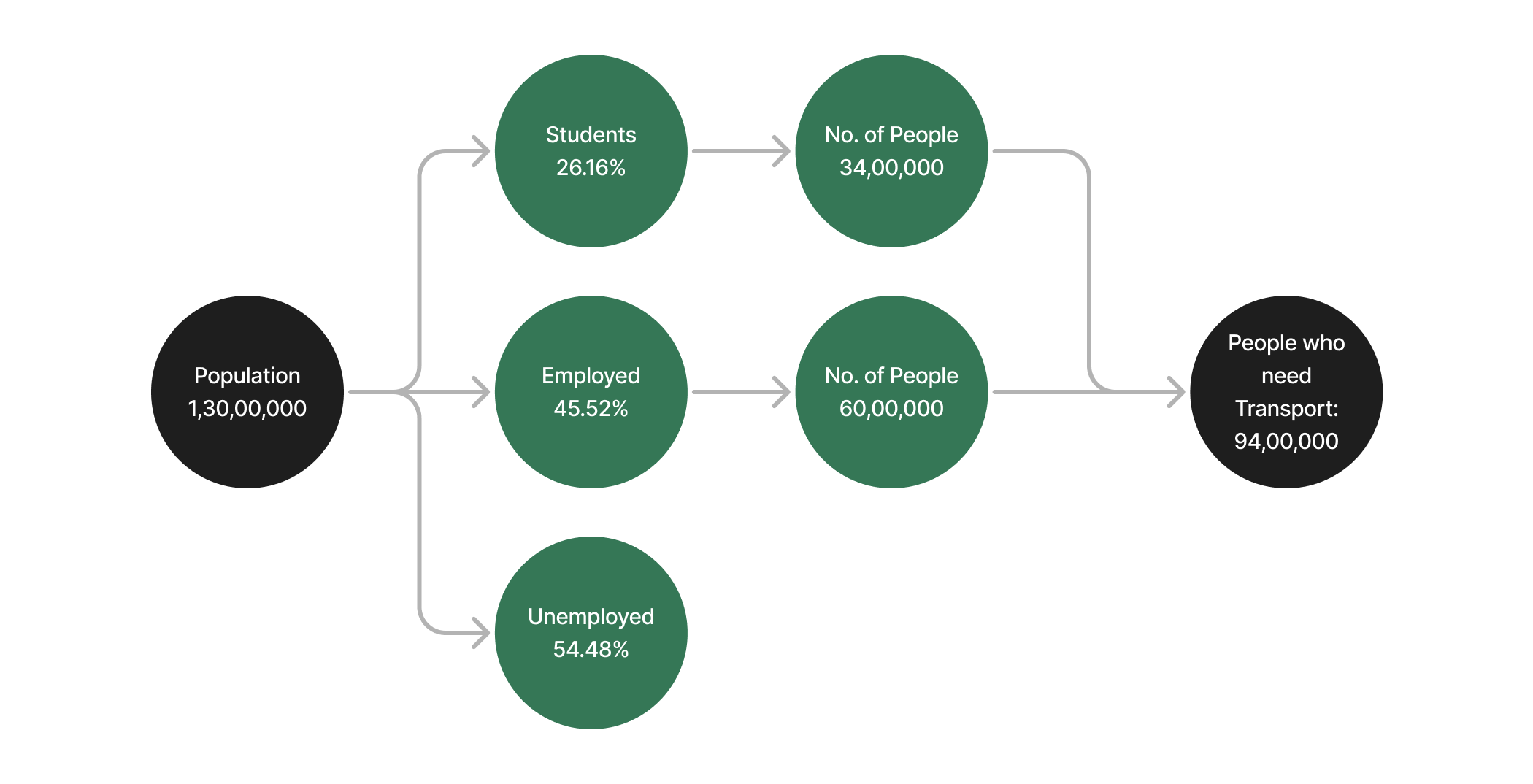
The Segment of population that requires commute consists mostly of employed people and students. The data is served from census 2011 which states the percentage of employed people as 45.2%, percentage of students aged 04-20 as 26.16% and population as 1.3 crore.
- Unemployed segments does not require everyday commute
- Students enrolled in schools require daily transport to reach
- All the employed segment people travel to work everyday
- People who use public transport will return using the same


STEP: 2
Target audience within Identified Segment
Age-wise population distribution
As per the 2011 census, the number of people within the age bracket of 20-29 are approximately 20,00,000
According to the data collected during a survey for preparing the annual states of education report (ASER) 2020, as much as 68.60% of the households in Karnataka have smartphones. In urban Bangalore, let us consider 75% smartphone usage due to higher income rates. Therefore our user group consists of about 1,50,000 people.

STEP: 3
Concluded Target Group
- Residents of Bangalore
- Employed or Students
- Users of Private Transport
- Age between 20-29 Years
- Access to Smartphones
Market Research
A crucial step of Secondary research invoved conducting a market study. This entitled a close examination of various initiatives globally that sought to gamify the commuting experience.
Beat the street, UK
Community wide program which improves the health and well-being of all ages. It leads to long term behavior change by creating a social norm around walking and cycling.
- All Ages can participate
- Includes walking and cycling
- Community and team involvement
- Point based reward system
- Participants needs RFID Card
- Dead locations with no ‘Beat boxes’
- Limited distribution and scalability

MARGe, Portugal
This project is located in Madeira Island, Portugal. Specifically, in the city of Funchal, one of the six European touristic sites known for tourism.
- Narrative structure in form of adventures.
- Hints provided to earn more points
- Badges awarded to participants
- Leaderboards and predefined quests
- Complicated for visiting tourists
- No real time reward system
- No shareability of progress

INSINC, Singapore
Singaporean adaptive platform based on the public Mass Rapid Transit (MRT) rail network. INSINC stands for “Incentives for Singapore Commuters”.
- Increased incentives for peak hours
- Social motivation included
- Credits proportional to distance travelled
- Credits are redeemable
- Variable raffle based point redemption
- No reinforcement for public transport
- Website based platform

Surveys & Interviews
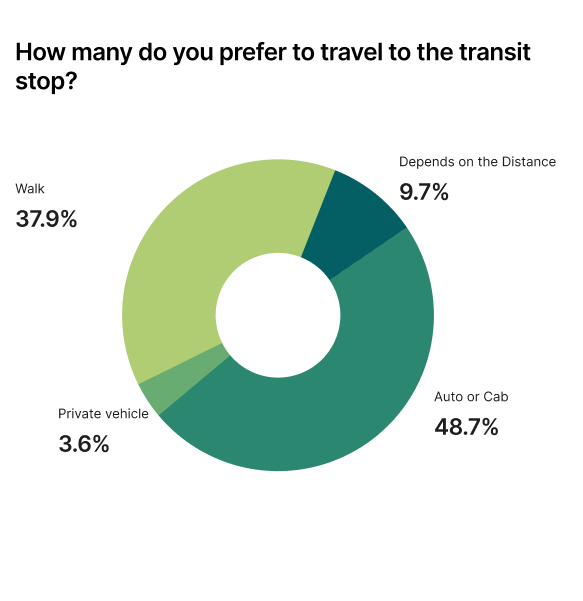
As a part of primary research, user interviews and surveys were conducted. The user interviews were taken over ZOOM, GMeet and surveys were floated around using Google forms




Insights
As a part of primary research, user interviews and surveys were conducted. The user interviews were taken over ZOOM, GMeet and surveys were floated around using Google forms

Field of Study
In order to understand the public transport system of Bangalore in greater depth, I decided to use the bus and metro system to cover a route of 35 kms within the city.

Metro
Bus
Auto
Walk
Journey

Observations
During the journey, I observed the people using the transport system and noted down their touch points and perceivable pain points. I also make sketches of the people I was traveling with.


Quantitative Analysis
In order to understand the public transport system in greater depth, I decided to use the bus and metro system to cover a route of 35 kms within the city.
Time Aspect

Financial Aspect

Social Aspect

User Personas


Empathy Maps


Story Board


Time Motion Map

Journey Map

Brain Dump
Brainstrom ideas on how to motivate people to use public transport
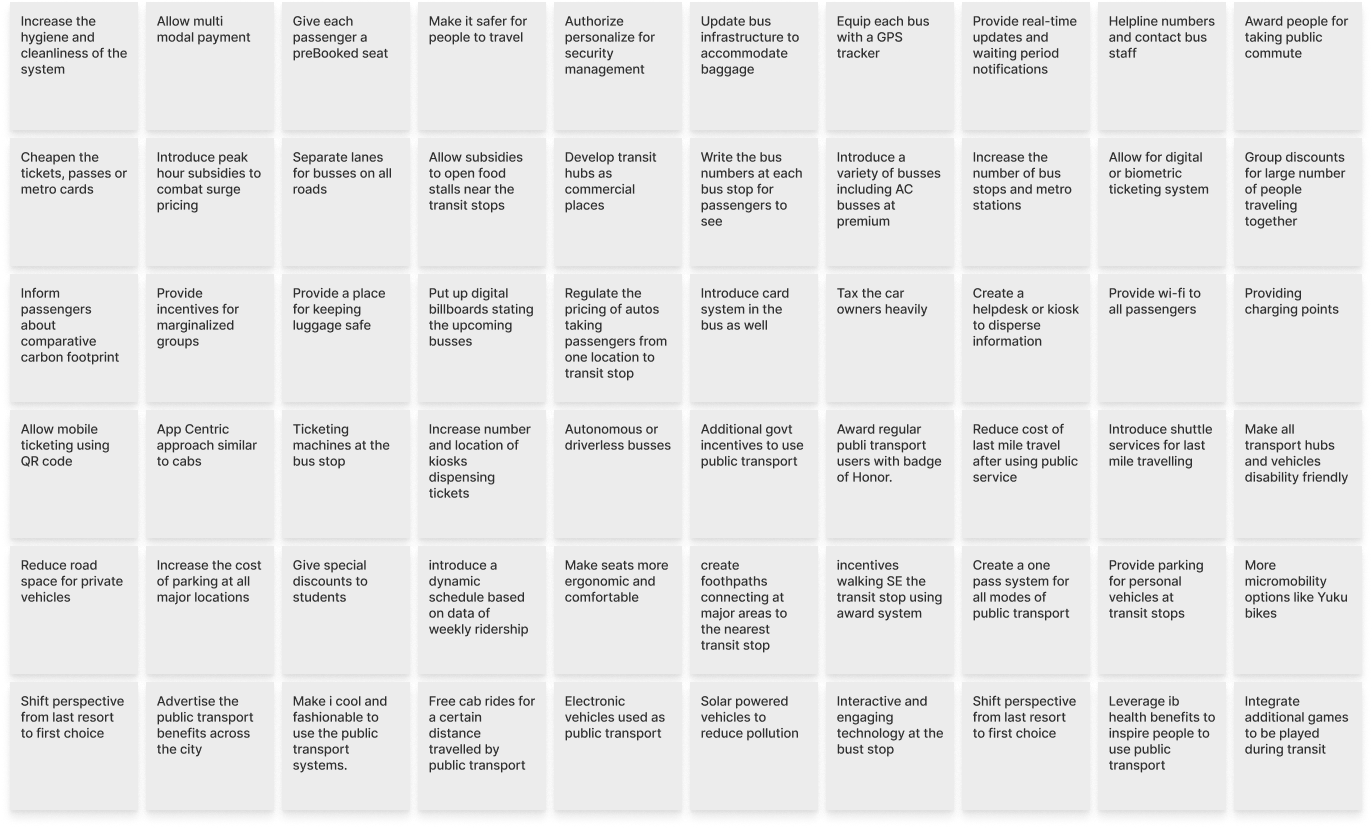
Affinity Mapping
Find broad themes from the ideas in brainstorming and create affinity groups

Board Themes
Identify the most relevant themes from the groups and select best ideas

Quick Concepts
Create quick concepts around the selected themes and score them to make the final selection

Game Design
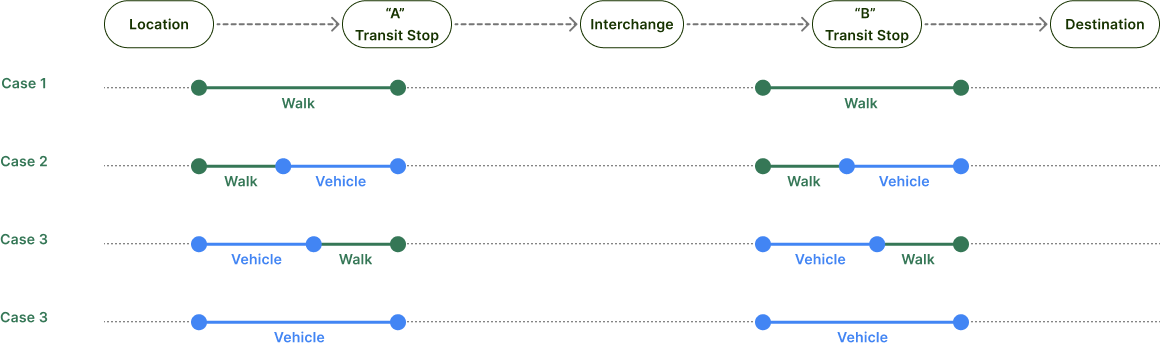
The rewards will be granted to those who travel to the bus stop or metro station-either by walking or a vehicle. After certain rewards or points are collected, user can redeem them on discounts on the next bus pass or metro card, thereby creating a positive reinforcement loop.
Permutations
There are 4 different permutations for a user to reach a transit stop
Progression
Considering the 4 cases, the game progression will be as follows.

Information Architecture & Task Flows

Key features on app
Challenges & Badges
Daily/Weekly missions (e.g., “Commute 5 days using Metro to earn a badge”), City exploration challenges
Real-Time Transit Integration
Live BMTC Tracking – Integrated with APIs, Smart Route Planning – Multimodal suggestions, Smart Alerts – Notifications for delays.
Community & Social Features
User Travel Tips – Users contribute transport insights, Transport Reviews & Ratings – Rate bus routes and drivers.
Government & Corporate Tie-ups
Partner with BMTC, Namma Metro, and companies for employee incentives
Health & Environment Tracking
Monitor carbon footprint reduction for users, Gamify walking/cycling achievements with health benefits.
Streaks & Rewards
Maintain a streak for eco-friendly travel, Redeem points for discounts on travel cards, or ride-sharing credits
User Engagement Analytics
Track user habits and preferences through data analytics, Personalized travel recommendations based on past usage patterns.
Competitive Advantage
Seamless integration, real-time community engagement, sustainability-focused mobility.
Feedback Mechanism
In-app surveys for user experience improvement, Quick feedback option for transit services.
Gamification Mechanics
Points System – Earn points for using public transport (BMTC, Metro, etc.), Walking/cycling short distances instead of using cabs, Carpooling with verified users
Wireframes


Key Screens


Prototype
Challenges
- Designing for daily commuters, tourists, and people with disabilities while ensuring accessibility.
- Integrating real-time feedback from users to improve service quality and user satisfaction.
- Creating personalized experiences based on user preferences and travel history.
- Enhancing safety features for vulnerable passengers during late hours.
Takeaways
- Reducing Drop-Off Rates
- Real-Time Support Reduces Drop-Offs
- Personalized User Journeys
- Enhanced Onboarding Process
- Streamlined Navigation Experience
- Optimizing for Mobile and Desktop